Do not harass the wildlife…

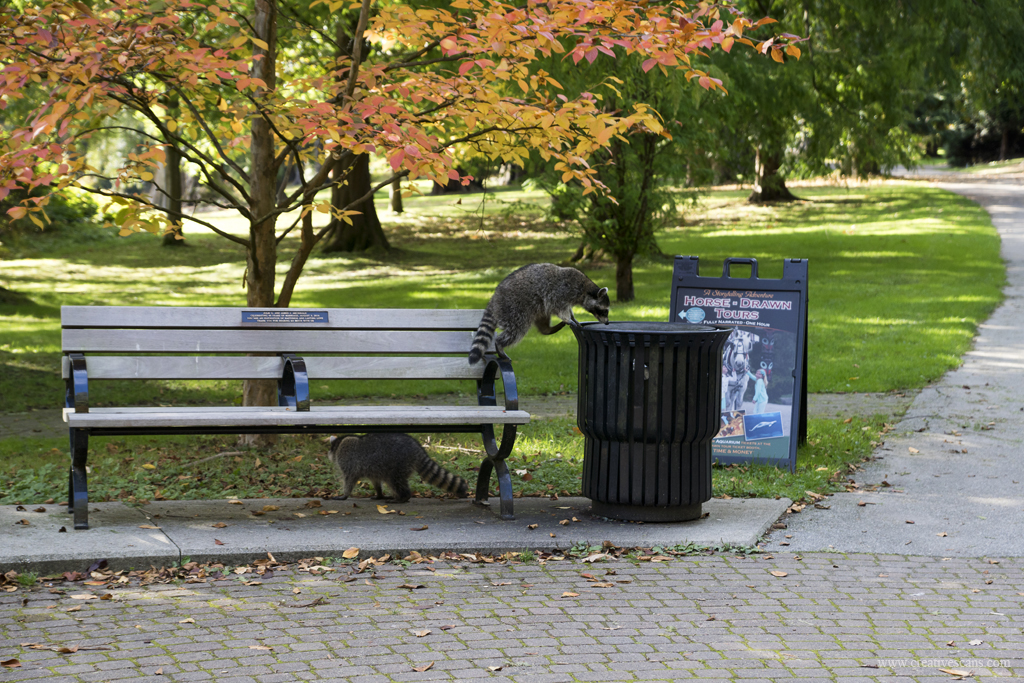
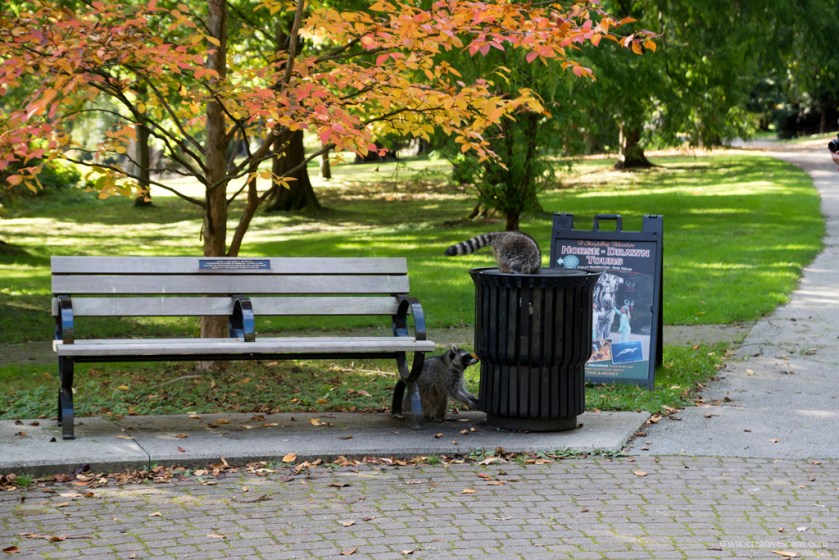
Quick story: I was out at Stanley Park photographing some fall colors and happened across a pair of raccoons checking out a trash bin looking for food. A young lady about 25-30 years old and her cycling partner stopped at this scene just after me. When the first raccoon went into the trash bin and disappeared I heard her say to her cycling partner; “I will get a stick and poke him out of there”. I said to both of them why would you do that? She said so that I can get a better look. I said no you will not do that. She said why not?! I said for one thing it is dangerous, they can and do bite, he will be out again in less than a minute and for another its just a stupid idea. They both cycled away without another word. Without poking any animals with a stick.

If you want to photograph wildlife do it from a respectful distance where you do not interfere with the animals. That is what zoom lenses are for.

As you can see by the photos the pair of raccoons did find something they found of interest.

dsc00220s
Raccoons in Stanley Park
dsc00221s
Raccoons in Stanley Park
dsc00224s
Raccoons in Stanley Park.

Burnaby RCMP Open House

I went to the Burnaby RCMP and City of Burnaby public safety Open House this past weekend. My focus was mainly on the different departments of the RCMP that were at the event including:

The Bomb Squad, with one of the bomb squad robots and other equipment on display (see photo) The robot has at least 4 cameras, microphones and is able to grasp things with an extendable gripper.

The Forensic Identification Unit. They provided really interesting information on finger print analysis and other techniques they use to solve crimes.

Mobile Command Center (see photo): Allows the RCMP to be on scene for extended periods of time. The unit has every imaginable radio communication device you can think of (see photo) along with other supplies needed to be on site for multiple days.

Sheriff Prisoner Transportation (see photo): The vehicles have compartments for groups of people and a single occupancy cpmpartment in the vehicle. Males and females are kept apart during transport. The single occupancy section can be used for people who might be particularly aggressive or if they are drunk and feeling ill.

Burnaby RCMP Police Dog Services Demo: In chatting with the officers involved with the PDS, I found out that the dogs are trained for only one job in addition to suspect apprehension. A dog can be trained to detect bombs or drugs but not both. You don’t want a dog to give a false positive or mix up or miss a detection.

Also at the event was the Traffic Enforcement section and the BC Ambulance Service and some of the ERT team. It really was an interesting event. I just wish it was not pouring rain that day!

YVR 2037 Master Plan Workshop

I recently attended the first of three YVR 2037 Master Plan Workshops at YVR. I view the 2037 Master Plan mainly from a plane spotter/aviation enthusiast point of view with an interest in the airport providing more plane spotting amenities. Here are a few thoughts:

The YVR Master Plan and workshops cover more than just plane spotting. They cover 6 key components; terminals, airside and airspace, ground access, environmental, amenities and land use. Creating new plane spotting areas touches on several of these areas. The airport had many top level people at the session actively involved in the discussions including Craig Richmond CEO of the airport, as well as people in charge of or with solid knowledge in the above 6 key areas. There were about 6 groups of a half dozen or so people in each group participating in the workshop. If we had questions, most if not all, got answered. If questions couldn’t be answered on the spot they would follow up at a later time. No concrete time lines are in place for any of the topics covered. These are sessions to discuss ideas for the near and medium future and give feedback about current and future aspects of the airport. The discussion guide is an interesting document to read. It can be found here:

http://www.yvr2037.ca/our-futurist/documents/3856/download

Plane spotting is specifically mentioned on page 27:

“Plane Spotting Platform: Design and construct a viewing area, just west of the Canada Post building, including parking, path and a covered plane spotting deck.”

And here:

“Plane Spotting Platform: Design and construct a plane spotting platform in the grassy area just north of the jetSet parking lot and west of the future North-South Taxiway.”

When plane spotting was brought up in our group here is some of what was brought up:

Provide a shuttle or some other means of transport to get to and from the spotting locations. Dedicated shuttle similar to the south terminal shuttle, or transit or maybe partner with the Canada Post Shuttle (that runs almost empty most parts of the day).

Connect spotting locations with bicycle paths and other Sea Island amenities.

Make the spotting locations camera friendly (no chain link fencing or glass to shoot through)

Have a covered area included in the spotting location.

Include toilet facilities at the spotting locations.

Put in a sidewalk to Larry Berg Flight Path Park from BCIT.

There is another opportunity to get involved and learn more about the future at the airport at the upcoming open house on Wednesday October 12, from 4pm to 8pm. It is being held at the Observation Area in the Domestic Terminal at YVR.

It was an interesting event to attend. Below are a few photos taken at the event. And here is a link so some of my aviation related images: https://www.flickr.com/photos/zorro1968/albums/72157646707011000

Mobi Bike Share Vancouver

Mobi Bike Share started up in Vancouver recently. Think car share but with bikes. Full details on how to sign up, access and return the bikes are available on their website but basically you sign up, fill in some information to create an account, pick your plan,  receive your user code and you are good to go. The service is geared for trips lasting less than an hour. If you plan on riding for longer than an hour or in a group like with family it is recommended you go to a traditional bike rental business (they have a list of places to rent biked for longer periods of time on their website).

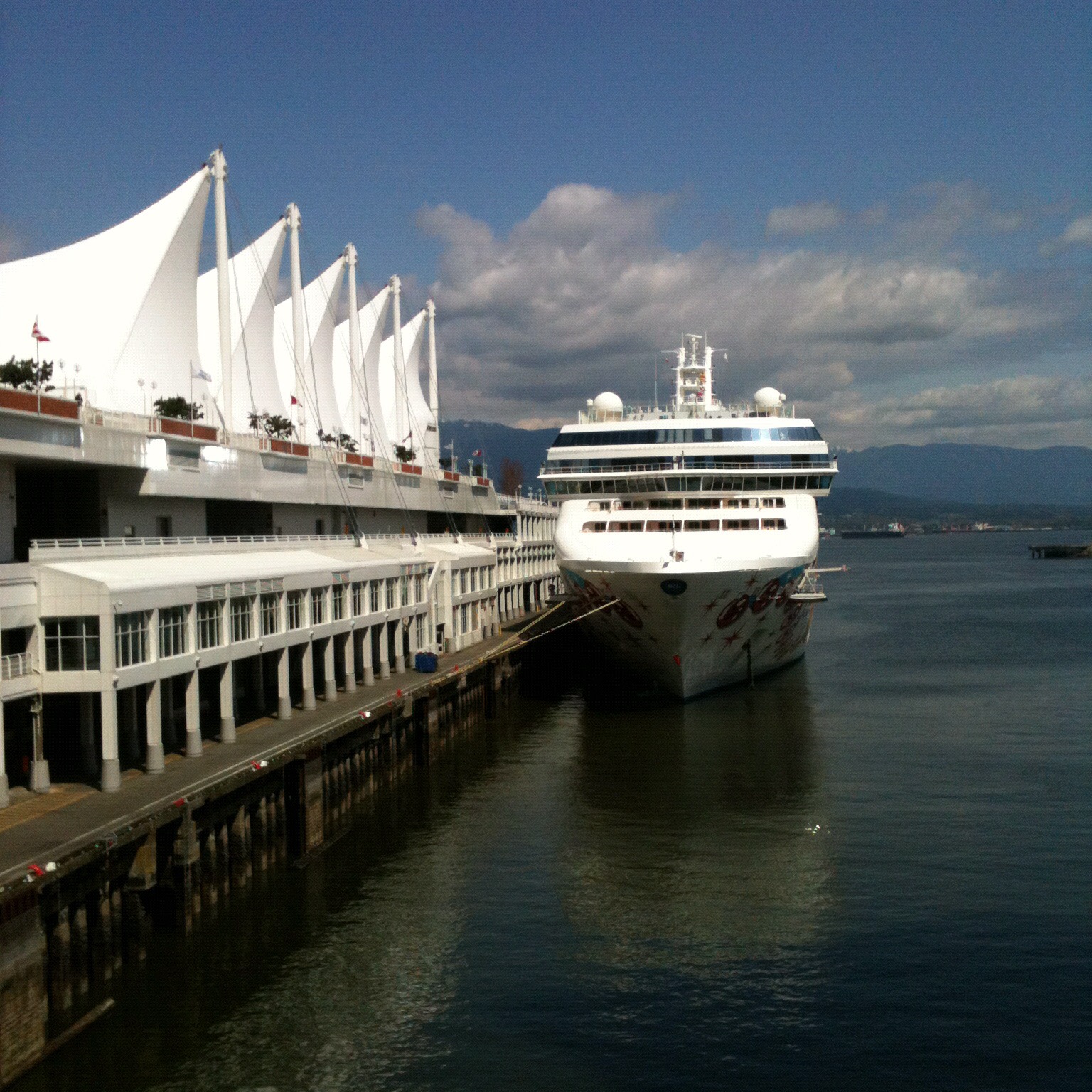
I was walking by Canada Place recently and passed one of the Mobi Bike Share dock stations. (Eventually there will be 150 dock stations and 1500 bikes in the sytem.) When I passed by the station at around 3:30 pm it was pretty much full with bikes available to rent. On my way home around 6:30pm I passed the same dock station and most of the bikes available for rent were gone. (See photos.) The fact that most of the bikes were not at the station seems like a good sign that the idea and business are off to a good start.

So if you are in the downtown core and need a bike for short trips check them out.

Another Race Day

One of my two horses Merlot, number 3 in the photos, ran this past holiday Monday. It didn’t start as a close race with the field strung out in a line, but the end of the race added some excitement in seeing who would come in 3rd and 4th. A win would elude us this day and we would finish a very close 4th. That’s racing.

Photographing fireworks basics

If you missed the fireworks on Canada Day or July 4 or want try your hand at photographing fireworks you have another chance during the http://hondacelebrationoflight.com/ in the Vancouver area July 23, 27 and 30th.

So here are some basic tips on how to photograph fireworks.

Try to scout out your location before the event. Know where the fireworks display will be and where you will shoot in relation to that location. Finding a location that will give you an unobstructed view of the fireworks is key. With popular fireworks shows there will be A LOT of people at the event so plan for this. You do not want to set up in a spot nice and early only to have people end up in front of you blocking your view. And it is best to get into your position as early as possible. I usually try and be at my spot at least 3 hours prior to the show starting.

As far as gear is concerned I use a Sony A77ii DSLR but you could use a point and shoot camera with manual settings or a “Fireworks” setting. No matter what camera you use, it is best to have and use a good sturdy tripod. The shutter stays open for relatively long periods of time when shooting fireworks and if you try to hand hold the camera you will end up with blurry pictures. Using a sturdy tripod can help eliminate camera shake and blurry pictures.

If you can, use a cable release to activate the shutter to take the photos. If you do not have a cable release or the camera does not support a cable release then use the self-timer function to activate the shutter. Using a cable release minimizes how much the camera moves to activate the shutter…your finger doesn’t touch the camera it touches the cable. Using the self-timer gives the camera time to settle down after your finger pushes the shutter button. Many cameras have a self-timer function that lets you delay the shutter by 2-3-4 or 10 seconds. I have used the 2 second delay with good results when I have forgotten the cable release.

The camera settings that I find work best for photographing fireworks are pretty straight forward. Most often I use shutter speeds of between 2 and 6 seconds, an aperture of between f7 and f11 and ISO of between 100 and 400. You will need to play around with the settings to see what works best for you and your situation but these settings can be used as a decent starting point. I will change camera settings during the show if segments of the show are brighter or less bright to try and get the best results but don’t get carried away with changing settings during the show.

Next tip. Shoot a lot. Especially when you are starting out. Don’t expect all your photos of a fireworks display to be award winners. If you take more photos you increase the chances of you getting some really pleasing images. Like anything else, if you keep at it and do it enough you will find that you will have more and more good images from each display you photograph.

A few words about composition. You can focus tight on the fireworks and that is perfectly ok or you can try and add other elements to the composition to try and give the photos a sense of place. If you add in your city skyline or maybe a prominent building or bridge to the fireworks photos it can really add something special to the final photograph.

There are other more “advanced” techniques to photographing fireworks but I hope these few tips help you’re your next fireworks photos a little better. Below are a few fireworks photos I have taken over the years.

Canada day citizenship ceremony…

I attended a citizenship ceremony for the first time on Canada Day. I was surprised how emotional it can be just watching (and photographing) the proceedings. For the people getting their citizenship it must be a really emotional day.

From a photography stand point it can be a challenge to photograph events inside a large indoor space (one of the halls at Canada Place in this case) with low light, different colors of light, crowds of people getting in your shots as well as other photographers and media people jockeying for position to get good images.

On the plus side most everyone is in a good mood. And hey there was cake! And when there is cake it’s usually going to be a good event.

I hope everyone had a Happy Canada Day!

Watched Shooting Jacket workout…

Watched Shooting Jacket workout…

I went to Hastings Racecourse early Wednesday morning to watch one of my two horses, Shooting Jacket, workout. Trackside, the smell of coffee and hay were in the air along with the occasional whiff of horse poop. When you are this close to the action you get all the sights and smells. There were more owners horses trainers and agents of different horses at this workout session compared to the last session I attended a few weeks back. Everyone seems to know everyone and is very friendly. I am still getting to know people but it’s all good.

Shooting Jacket ran a few slow laps or parts of laps around the track, then did at least one flying lap at a good clip. Then it was back into the paddock and barns and the word is he is in good shape. I think Shooting Jacket and Merlot are both running on Canada Day but need to confirm that.

Below are a few photos of Shooting Jacket working out Wednesday morning. This was the first time using the new Sony A77ii at the track. It was a good real world test to help me get used to the new equipment and I am fairly happy with these early images..

For more on how I got involved with horse racing check my previous post here:

https://creativescans.wordpress.com/2016/05/24/so-i-bought-a-race-horse/

For more information about Hastings Racecourse visit their website:

http://www.hastingsracecourse.com

Fraser River Marine Pilots…

I attended a really interesting presentation at the Port of Vancouver’s Delta Community Office given by Captain Mike Armstrong, who has been a Fraser River Pilot for 15 years and is one of only 8 Fraser River Pilots that work the Fraser River. There are two types of marine pilots, Coastal and River, both guide ships through local waters to and from a port. Captain Mike talked about many different aspects of becoming and being a Fraser River pilot…

To become a pilot, either River or Coastal is not easy. You first need a lot of experience on the waters in which you hope to work before you can even apply to become a marine pilot. Then there is the extensive 3 part testing program that must be completed. The testing consists of a written general knowledge test, a written local knowledge test and then an extensive oral exam. You must pass (70%+) each of the tests before moving on to the next test…fail one and you do not move on to the next. To pass the local knowledge test you must memorize, among other things the locations of markers and buoys, depth of water at various places along the river, height of bridges, width of channels and a lot more. There is also on the job training and mentoring that must be completed before becoming a full on River or Coastal Pilot.

People wishing to becoming marine pilots often start their career on the water working on fishing boats, ferries, tug boats, deep sea vessels or with the coast guard. Because it takes so long to gain the necessary experience to become a marine pilot you won’t find too many really young marine pilots. And because it takes so much experience in either River or Coastal waters to become a River or Coastal Pilot it is very rare for a pilot to work in both areas or switch from one area to the other.

When a ship needs to move up the Fraser River from the ocean, the Pilot boards the ship about 7 miles off shore and about 3 miles outside the mouth of the river. This gives the Coastal Pilot who guided the ship through the outer local waters of the BC coast, the River Pilot and Captain of the ship time to brief each other before starting the passage up the river. The Coastal Pilot then leaves the ship while the River Pilot remains on board and takes over navigation of the ship. When the ship leaves port the process is reversed.

Getting on and off a ship in open water in all weather conditions and at all times of the day or night is probably the most dangerous hazard a marine pilot faces. I know off the coast of Oregon at the mouth of the Columbia River they will use a helicopter to transfer a marine pilot to or from a ship if the weather is too bad for a water based transfer.  There is some talk of a helicopter being used along the BC coast to transfer pilots to and from ships when needed in the future. Right now if the waters are too rough to transfer a pilot off a ship that is leaving the BC coast, that pilot will try and get off the ship around Victoria on Vancouver Island. If getting off the ship is still not possible due to bad weather the pilot stays on board that ship until its next port of call…no matter where in the world that might be.

Some other interesting things I learned about being a Marine Pilot:

No tax dollars are used to pay for piloting services, it is all paid for by the ships using the services.

When a pilot first starts working they do not start with the very largest ships. The size of ships they are allowed to pilot will increase over about a 5 year period.

It is the pilot who orders the tugs used to help guide the large ships in and out of port. The pilot figures out in advance what type and how many tugs will be needed for a particular job.

Pilots are consulted before a new bridge or dock is built and can provide valuable feedback on how a bridge or dock should be designed.

Sometimes 2 pilots are on board a ship if it is a particularly challenging assignment.

The Fraser River is surveyed constantly to monitor the depth of the river. This information is made available to stakeholders including marine pilots on a daily basis.

There is a lot more to being a Marine Pilot and their roles and responsibilities than I have covered here. If you would like more information you can find it at:

The Fraser River Pilots website:

http://www.fraserpilots.com/

The Canadian Marine Pilots’ Association website:

http://www.marinepilots.ca/index.html

The International Maritime Pilots’ Association:

http://www.impahq.org/

More information about the Port of Vancouver

http://www.portvancouver.com/