Spur of the moment photo op…

On Canada Day, July 1, 2016, I had the pleasure of meeting and photographing two prominent broadcasters, Red Robinson and Chris Gailus. To have two prominent broadcasters in the same room at the same time is rare, so I took the opportunity to photograph both Red and Chris together.

I waited for an opportune moment to get their attention, introduced myself and asked if I could get a photo of both of them together and they both agreed. Before approaching them I made sure my camera was ready and had an idea of how/where I wanted them to stand for the photo. We were in front of a stage that was brightly back lit so I had them stand with the stage at my back and them facing the stage. If I had them in front of the stage back lit by the lights of the stage the photo would not have turned out the way I wanted.

Both asked for a copy of this photo and Red used it in his blog which you can see here. Pretty cool. Thank you Red and Chris for posing for the photo.

Photographing fireworks basics

If you missed the fireworks on Canada Day or July 4 or want try your hand at photographing fireworks you have another chance during the http://hondacelebrationoflight.com/ in the Vancouver area July 23, 27 and 30th.

So here are some basic tips on how to photograph fireworks.

Try to scout out your location before the event. Know where the fireworks display will be and where you will shoot in relation to that location. Finding a location that will give you an unobstructed view of the fireworks is key. With popular fireworks shows there will be A LOT of people at the event so plan for this. You do not want to set up in a spot nice and early only to have people end up in front of you blocking your view. And it is best to get into your position as early as possible. I usually try and be at my spot at least 3 hours prior to the show starting.

As far as gear is concerned I use a Sony A77ii DSLR but you could use a point and shoot camera with manual settings or a “Fireworks” setting. No matter what camera you use, it is best to have and use a good sturdy tripod. The shutter stays open for relatively long periods of time when shooting fireworks and if you try to hand hold the camera you will end up with blurry pictures. Using a sturdy tripod can help eliminate camera shake and blurry pictures.

If you can, use a cable release to activate the shutter to take the photos. If you do not have a cable release or the camera does not support a cable release then use the self-timer function to activate the shutter. Using a cable release minimizes how much the camera moves to activate the shutter…your finger doesn’t touch the camera it touches the cable. Using the self-timer gives the camera time to settle down after your finger pushes the shutter button. Many cameras have a self-timer function that lets you delay the shutter by 2-3-4 or 10 seconds. I have used the 2 second delay with good results when I have forgotten the cable release.

The camera settings that I find work best for photographing fireworks are pretty straight forward. Most often I use shutter speeds of between 2 and 6 seconds, an aperture of between f7 and f11 and ISO of between 100 and 400. You will need to play around with the settings to see what works best for you and your situation but these settings can be used as a decent starting point. I will change camera settings during the show if segments of the show are brighter or less bright to try and get the best results but don’t get carried away with changing settings during the show.

Next tip. Shoot a lot. Especially when you are starting out. Don’t expect all your photos of a fireworks display to be award winners. If you take more photos you increase the chances of you getting some really pleasing images. Like anything else, if you keep at it and do it enough you will find that you will have more and more good images from each display you photograph.

A few words about composition. You can focus tight on the fireworks and that is perfectly ok or you can try and add other elements to the composition to try and give the photos a sense of place. If you add in your city skyline or maybe a prominent building or bridge to the fireworks photos it can really add something special to the final photograph.

There are other more “advanced” techniques to photographing fireworks but I hope these few tips help you’re your next fireworks photos a little better. Below are a few fireworks photos I have taken over the years.

Canada day citizenship ceremony…

I attended a citizenship ceremony for the first time on Canada Day. I was surprised how emotional it can be just watching (and photographing) the proceedings. For the people getting their citizenship it must be a really emotional day.

From a photography stand point it can be a challenge to photograph events inside a large indoor space (one of the halls at Canada Place in this case) with low light, different colors of light, crowds of people getting in your shots as well as other photographers and media people jockeying for position to get good images.

On the plus side most everyone is in a good mood. And hey there was cake! And when there is cake it’s usually going to be a good event.

I hope everyone had a Happy Canada Day!

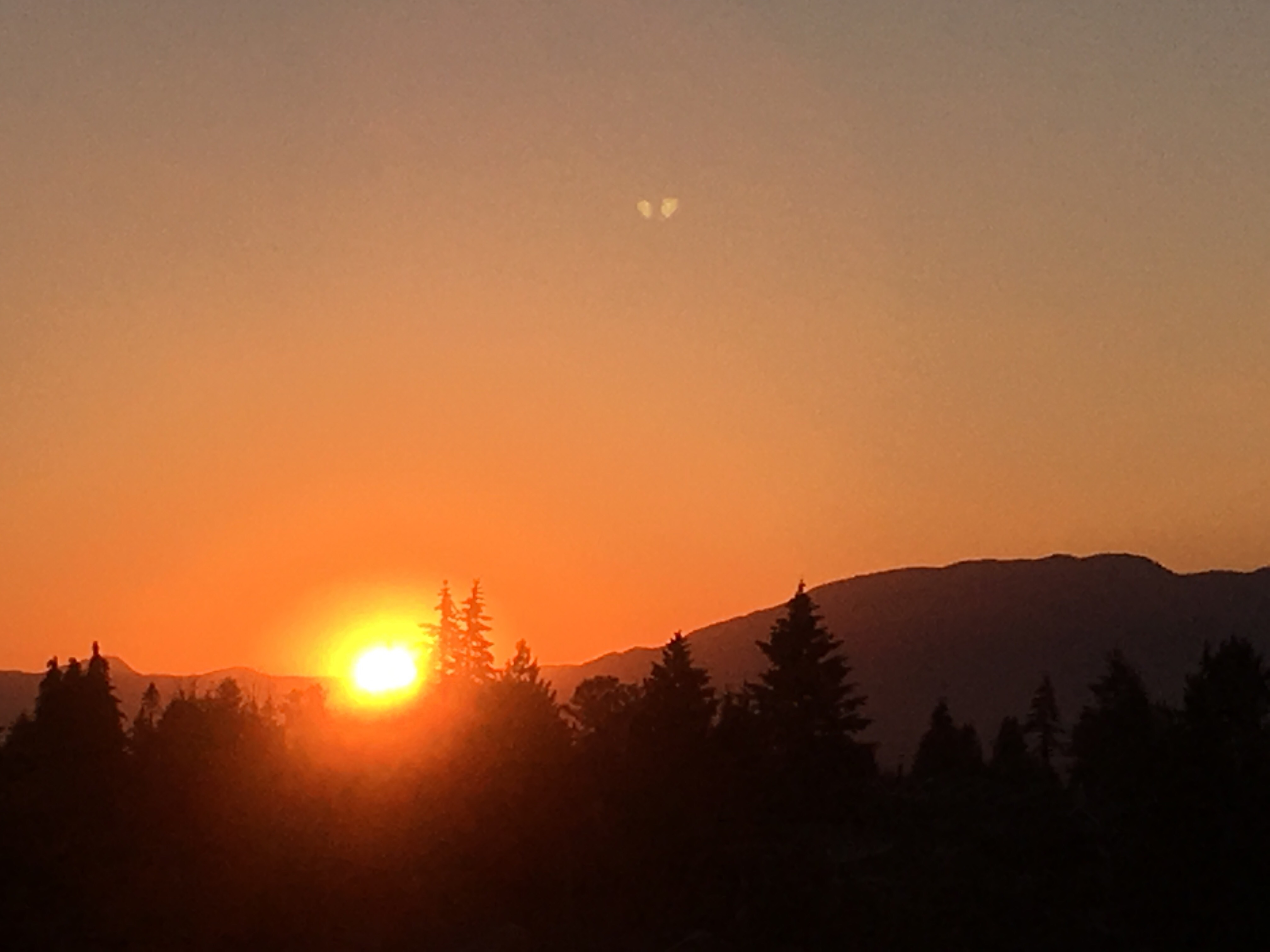
Sunset photos with an iPhone

Quick tip…To change the exposure of a sunset photo (or any photo) tap the screen in the dark or light areas. This will make the exposure longer or shorter depending on which area you tap.
Tap the the screen in the lightest area for a shorter exposure time and the shadow areas will be darker. Tap the darker areas for a longer exposure and the darker areas will be lighter.
In the photo below I tapped the lightest area (the sun). Notice the shadow areas are pretty much totally black.

Watched Shooting Jacket workout…

Watched Shooting Jacket workout…

I went to Hastings Racecourse early Wednesday morning to watch one of my two horses, Shooting Jacket, workout. Trackside, the smell of coffee and hay were in the air along with the occasional whiff of horse poop. When you are this close to the action you get all the sights and smells. There were more owners horses trainers and agents of different horses at this workout session compared to the last session I attended a few weeks back. Everyone seems to know everyone and is very friendly. I am still getting to know people but it’s all good.

Shooting Jacket ran a few slow laps or parts of laps around the track, then did at least one flying lap at a good clip. Then it was back into the paddock and barns and the word is he is in good shape. I think Shooting Jacket and Merlot are both running on Canada Day but need to confirm that.

Below are a few photos of Shooting Jacket working out Wednesday morning. This was the first time using the new Sony A77ii at the track. It was a good real world test to help me get used to the new equipment and I am fairly happy with these early images..

For more on how I got involved with horse racing check my previous post here:

https://creativescans.wordpress.com/2016/05/24/so-i-bought-a-race-horse/

For more information about Hastings Racecourse visit their website:

http://www.hastingsracecourse.com

Fraser River Marine Pilots…

I attended a really interesting presentation at the Port of Vancouver’s Delta Community Office given by Captain Mike Armstrong, who has been a Fraser River Pilot for 15 years and is one of only 8 Fraser River Pilots that work the Fraser River. There are two types of marine pilots, Coastal and River, both guide ships through local waters to and from a port. Captain Mike talked about many different aspects of becoming and being a Fraser River pilot…

To become a pilot, either River or Coastal is not easy. You first need a lot of experience on the waters in which you hope to work before you can even apply to become a marine pilot. Then there is the extensive 3 part testing program that must be completed. The testing consists of a written general knowledge test, a written local knowledge test and then an extensive oral exam. You must pass (70%+) each of the tests before moving on to the next test…fail one and you do not move on to the next. To pass the local knowledge test you must memorize, among other things the locations of markers and buoys, depth of water at various places along the river, height of bridges, width of channels and a lot more. There is also on the job training and mentoring that must be completed before becoming a full on River or Coastal Pilot.

People wishing to becoming marine pilots often start their career on the water working on fishing boats, ferries, tug boats, deep sea vessels or with the coast guard. Because it takes so long to gain the necessary experience to become a marine pilot you won’t find too many really young marine pilots. And because it takes so much experience in either River or Coastal waters to become a River or Coastal Pilot it is very rare for a pilot to work in both areas or switch from one area to the other.

When a ship needs to move up the Fraser River from the ocean, the Pilot boards the ship about 7 miles off shore and about 3 miles outside the mouth of the river. This gives the Coastal Pilot who guided the ship through the outer local waters of the BC coast, the River Pilot and Captain of the ship time to brief each other before starting the passage up the river. The Coastal Pilot then leaves the ship while the River Pilot remains on board and takes over navigation of the ship. When the ship leaves port the process is reversed.

Getting on and off a ship in open water in all weather conditions and at all times of the day or night is probably the most dangerous hazard a marine pilot faces. I know off the coast of Oregon at the mouth of the Columbia River they will use a helicopter to transfer a marine pilot to or from a ship if the weather is too bad for a water based transfer.  There is some talk of a helicopter being used along the BC coast to transfer pilots to and from ships when needed in the future. Right now if the waters are too rough to transfer a pilot off a ship that is leaving the BC coast, that pilot will try and get off the ship around Victoria on Vancouver Island. If getting off the ship is still not possible due to bad weather the pilot stays on board that ship until its next port of call…no matter where in the world that might be.

Some other interesting things I learned about being a Marine Pilot:

No tax dollars are used to pay for piloting services, it is all paid for by the ships using the services.

When a pilot first starts working they do not start with the very largest ships. The size of ships they are allowed to pilot will increase over about a 5 year period.

It is the pilot who orders the tugs used to help guide the large ships in and out of port. The pilot figures out in advance what type and how many tugs will be needed for a particular job.

Pilots are consulted before a new bridge or dock is built and can provide valuable feedback on how a bridge or dock should be designed.

Sometimes 2 pilots are on board a ship if it is a particularly challenging assignment.

The Fraser River is surveyed constantly to monitor the depth of the river. This information is made available to stakeholders including marine pilots on a daily basis.

There is a lot more to being a Marine Pilot and their roles and responsibilities than I have covered here. If you would like more information you can find it at:

The Fraser River Pilots website:

http://www.fraserpilots.com/

The Canadian Marine Pilots’ Association website:

http://www.marinepilots.ca/index.html

The International Maritime Pilots’ Association:

http://www.impahq.org/

More information about the Port of Vancouver

http://www.portvancouver.com/

My horse placed 2nd…

One of my two horses, Merlot, ran in the 2nd race at Hastings Racecourse this past Saturday and placed 2nd in the race. It was a busy day at the track due to the Belmont Stakes being run in the USA but being shown live on the big screen at Hastings. A had a friend with me on this day but I still followed my race day routine. I get to the track early enough to pick up my free program and sign up for paddock access and chat with a few people I have met at the track. We then went inside and had a sit down lunch at Jerome’s where there is pub style seating. After lunch we walked around a bit, placed a small wager or two for a few races (including the Belmont) then watched the first race.

After the first race was over we made our way to the paddock along with several other owners to watch the horses get ready for the 2nd race… me with camera in hand of course. Merlot was looking good pre-race so hopes were high for a good strong finish and Jockey Ruben Lara and Merlot delivered. After the horses left the paddock to go on the track we made our way to the finish line area to try and get a good spot near the finish line and near the winners circle just in case Merlot had won the race. Merlot didnt win the race but finished a good 2nd place and came away in good shape.

I won’t be able to make it to the track this weekend due to other commitments but plan to be there next weekend where both of my horses, Merlot and Shooting Jacket, are scheduled to be running in the same race! Should be a very exciting day!

For more information about what is happening at Hastings Racecourse visit their website:

http://www.hastingsracecourse.com/

Sony A77ii camera HDR test

The Sony A77ii has a HDR setting so tried that feature out just to see the results. I rarely shoot HDR but wanted to see what the new camera could do. Below are a few images testing the HDR feature of the camera. The images are straight from the camera unedited except for being resized. Most of the menus are in the same places as the A77 but some have been redesigned so I am still getting used to the menus on board the camera.

My new camera arrived today…

The camera I ordered to replace my old malfunctioning camera arrived today. Here are my first very impressions.

The A77 and the A77ii are almost identical in design with a few differences that I have noticed so far. They have added a button you have to press to the center of the dial that changes shooting modes. If you do not push the button the dial will not move. Some of the menu layouts have changed. There is no more IF remote control. There is Wi-Fi. Oh and the flash hot shoe is now the traditional ISO type.

That’s all for now. Stay tuned for more information on the Sony A77ii and photos from out in the field using the new camera. Below are some photos of the new rig.

Look for a new perspective…

Photographically speaking, try shooting from a very low angle next time you are out and about with your camera. Show a subject you might photograph from normal or standing height from a new perspective. Try this on a subject you might never think of photographing. A few examples of what can make for an interesting photo if shot from a different perspective are flowers, walking paths, cars and tall buildings. There are a lot of things you can try this technique on so give it a try.

Below are a few examples of things photographed from a different perspective: